Tuesday, 27 August 2013

The patchwork quilt that made me want to sew hexagons

The patchwork quilt that made me want to sew hexagons

Do you remember the first encounter which sparked your wonderment of patchwork, the force that said to "I want to make one like that".  I was seven years old when that moment hit me.   My Mother took me to Torquay Museum in Devon.  I remember lots of stuffed birds in glass cases and fossils at the entrance.

We climbed the stairs to The Laycock Gallery situated on the top floor. My eyes immediately focused on a huge glass panel which housed a beautiful Hexagon Patchwork Quilt.    I studied with awe the neatness of the arranged small hexagons sewn together by hand.  The colours were not vibrant, mostly brown, beige, ochre and salmon pink, blues and olive green cotton fabric.  I was totally mesmerised by this massive beautifully crafted hexagon quilt.  I asked my mother to teach me how to sew hexagon patchwork.  She did.

The quilt that so inspired me was created by Marianna Louttit (circa 1835) and she lived in the village of Mylor in Cornwall.


About 23 years later 1989, writing for the American Magazine "Quilt World" Feb/March 1989 (see article below this blog), I revisited Torquay Museum in the hope that the quilt was still there.  It was, the  impact was just as powerful as I remembered.  I took the photographs reproduced in this blog.   Apologies for the poor quality.

Fast forward another 24 years to  August 2013, and the photographs re-surfaced in a long lost box of diaries.   For the third time in my life the memory of my happy childhood hit me.   Still sewing hexagons, still loving hexagons and happy knowing that thousands of ladies all over the world are creating patchwork quilts using hexagons purchased from my websites, produced from my own hands.
See: http://www.patchworktemplates.com


Saturday, 27 April 2013

Starting a creative business or project. Why you should photograph everything you make.

Starting a creative business or project.  Why you should photograph everything you make.


Throughout my creative business life spanning of over 30 years I always photographed everything I created.  No one told me to do this, it was just something I did.   When I first started out I did not realise the importance of this.  Now I do.

Over the last few days I have been sorting out all my photographic records of all sold waistcoats, about 850.    This comprises of several huge ring binder files crammed full of photographs in A4 plastic covers.   In addition I have several shoe box size plastic containers full of 6" x 4" photographs and some smaller albums.  At least a thousand photographs needed to be sorted and put into some order.    The reason for this quest was to look for a certain image of a garment I created many years ago.

My first camera was held closed with gaffer tape.  It worked and the images were just enough to create a recollection before selling.   Bearing in mind my first garments were created long before digital photography.   Then came computers and the wonderful facility of  selecting and editing images before printing.    Always print your photographs as you cannot rely on computers to preserve your images for the long term.   Think of your old family sepia albums.  Precious beyond words.

I am in the process of putting all my sold works online.  Its a mammoth task scanning and numbering each photographed garment.

Now for the scary revelation and the reason why you should photograph everything you make.   I am shocked to realise that I am scanning images of work I created 13 - 15 years ago of which I have no recollection creating.  I forgot  about a huge number of sold garments I made.   Crazy because each garment I create is an extreme labour intensive process from start to finish,  from cutting the cloth, planning the design, hand painting then embroidering before making into a garment.   Long hours of  intensive creative thought and energy.   How could I forget.

Keeping memories in your head is not enough.  Four images of work I completely forgot about.  Four of about 50.

All my works will be available online in the next few weeks. Contact me for further information.

Thanks for reading.


Friday, 12 April 2013

Fibonacci Patchwork - Waistcoats

Fibonacci Patchwork - Waistcoats 


I became fascinated by the Fibonacci sequence of numbers back in the mid 1980's.  Subsequently the article below was published in "Patchwork and Quilting" magazine summer 1990.   An easier version to read can be found on my website:  http://www.patchworktemplates.com/page12.htm.   I have also written a bit about it on my website www.jackiewills.co.uk.  Apologies as it needs updating.  Please contact me if you would like me to email a copy.

During my time at Cockington Court with the Devon Rural Skills Trust I created a Fibonacci waistcoat using shades of solid red glazed cotton chintz, some heavy upholstery fabrics and some beautiful fabric from Zoffany.   The hand sewn fibonacci design made a beautiful back.

To make this into a garment I added machine sewn crazy patchwork which brought it all together. I remember being quite haphazard with the machine sewing.  Unfortunately this image does not show the fine detail.  I wore it constantly until a lady approached me and wanted to buy it.   I explained it was well worn which did not deter.    During this time I received a number of commissions for a similar garment.  See images below:


The theme for this Fibonacci waistcoat was reds, blues and with some quite strong patterned fabric.  Most of it was hand-sewn with random machine embroidery and appliqué. The thing about machine embroidery on chintz is that you have to get it right first time as unpicking leaves visible machine holes.  The glossy glazed chintz combined with non glazed fabric created an interesting contrast.  

These photographs were taken on a cheap throwaway camera and do not show the detail.   This garment was created about 1991 and at the time was a very expensive commission.

Other fibonacci commissioned waistcoats are shown below:


Tuesday, 2 April 2013

How the internet changed my creative life.....................

How the internet changed my creative life.   The timeline dates back to the late 1980's when visiting a friend at Oxford University and being shown electronic mail.   In seconds a computer written letter was transported instantly to another electronic mail address in Italy.   It was a revelation and I gasped at this new technology, it was magic.

Fast forward to about 1996 when "Tiny Computers" and other computer manufacturers advertised all in one packaged bundles of software with a printer and loads of other bits.   I remember visiting the shop in Exeter and carrying all these boxes back to the car.   The cost was over £1000 which seemed a huge amount to spend.   The thing was I needed a new computer as the basic one I had was mono and unpredictable.  We were going through a major legal situation at the time and  needed a reliable machine.

With the package came a CD disc saying "internet"  and I immediately wanted to try it out.   I plugged it into the phone socket .....beep beep.......and hey presto.....internet live........it was a doddle.   Email was set up with lineone and was touch and go whether a connection would fire...........remember those beeeep beeeep sounds.......

Shortly afterwards my Dad followed the internet trend and somehow managed to upload  the image on the right. I think he must have done it via a CD.   I am wearing of one of my early chintz patchwork waistcoats.  At the time it was a real performance trying to link it to an art website.  Working on my own I persevered and learnt by trial and error.   To think that the whole world could see my work by clicking a few letters on the keyboard, was sort of overwhelming.   The search engine I used was AltaVista  or Lycos, before Google was born.

Realising the potential to market/sell my work I
started by looking at Ebay.  In those days the listings seem to consist of sunglasses and other items based in USA.  Not much down in Devon.

I paid a professional to create my first website. It was rubbish and a waste of money, but at least I had a profile on the internet which unfortunately I could not update.

The next time I looked at Ebay was in 1993.  Technology had moved a long way, digital cameras and scanners where almost common place.   My first sale on Ebay was a book on Crewel Embroidery.   It was a great thrill to see the item go green with a bid.    From there I progressed to selling fabrics from my collection.  In those days I remember selling vintage fabric packs for much more than they would achieve these days.  From there I started selling patchwork paper templates and waistcoats, firstly on Ebay then creating my own websites with shopping carts.  

Pre-internet most my sales were from galleries and exhibitions.   These events were very enjoyable and profitable but extremely time consuming.  Sometimes I think I should do a few shows here and there but then do I really need too.  Not at this moment, No.

Life has been very busy and rewarding using the internet as a selling tool.    Its wonderful to be able to read emails from happy customers and get to know people who buy frequently.

Yes, the internet has changed my creative life.


Monday, 18 March 2013

Starting a small creative business. Those early days.

Starting a small creative business.  Those early days.


I first opened my studio 1991 at Cockington Court, Torquay.  Having a studio at Cockington Court with the Devon Rural Skills Trust enabled people to see me working, demonstrate and commission work in person.

Studio at Cockington Court 1991


Working in a studio environment with other craftspeople around was great fun and incredibly inspiring.  It was great to bounce ideas and hear first hand reports of creative opportunities.   Having the general public walk through the studio all day took some getting used too.  Patterns formed with comments made.  The first word uttered would become a predictable sentence, such as "how" and I would know the following words would be "did it take you to make that", or "you" and "must have good eyesight to do that".  Sentences referring to the word "patience" were incredibly frequent.  My Fibonacci Quilts in particular took quite a bit of explaining and very time consuming.    After a while I typed a sheet of "frequently asked questions", covered it with plastic and attached it to the table.   It was easy then to point to the information smile and carry on working.

One of the most memorable moments was when my studio was full of people and I was giving my usual spiel on Fibonacci.  Having repeated this mantra many times I basically felt like a monkey in a zoo with all these people staring at me.  After a while I became aware of someone in the audience who looked very familiar, and in a dumb sort of way I sort of associated him with my then American boyfriend.  This person asked me loads of questions about my work.   The buzz later in the building was that a world famous actor had walked through unrecognised.   I checked out a picture, and yes, it was him.   Oh, my goodness!!


Studio at Cockington Court 1991

Sometimes a member of the public would come out with a real nugget of useful information.   One of the best bits of advice I ever received was from a gentleman who had some knowledge of the Italian Murano Glass industry.  He looked thoughtfully at all my work and said I must start producing smaller, cheaper products to earn a "bread and butter" income, as long term I would not be able to rely on commissions, teaching and selling my signature works.  Hand sewing would never give me a living wage. This was really hard to accept,  but he was right I and started to diversify by creating kits, fabric parcels, and waistcoats.  This advice maybe obvious but at the time I was so passionate about sewing by hand and producing signature pieces that compromise was not an option.


When I look back at those days I wondered how I survived, being single I had to support myself  with  accommodation,  studio rent, electricity, water rates and council tax bills to pay. Plus food.  My mother used to take me to the supermarket one day a week which was very helpful.  No mobiles, cars, internet, insurance, loans or other costly items.   I cycled everywhere and kept life very simple indeed.  It was a very happy existence...........then came the internet.........

My next blog will be about how the Internet changed my creative life.


Tuesday, 12 March 2013

The Roman Archaeology Waistcoat by Jackie Wills

The Roman Archaeology Waistcoat by Jackie Wills


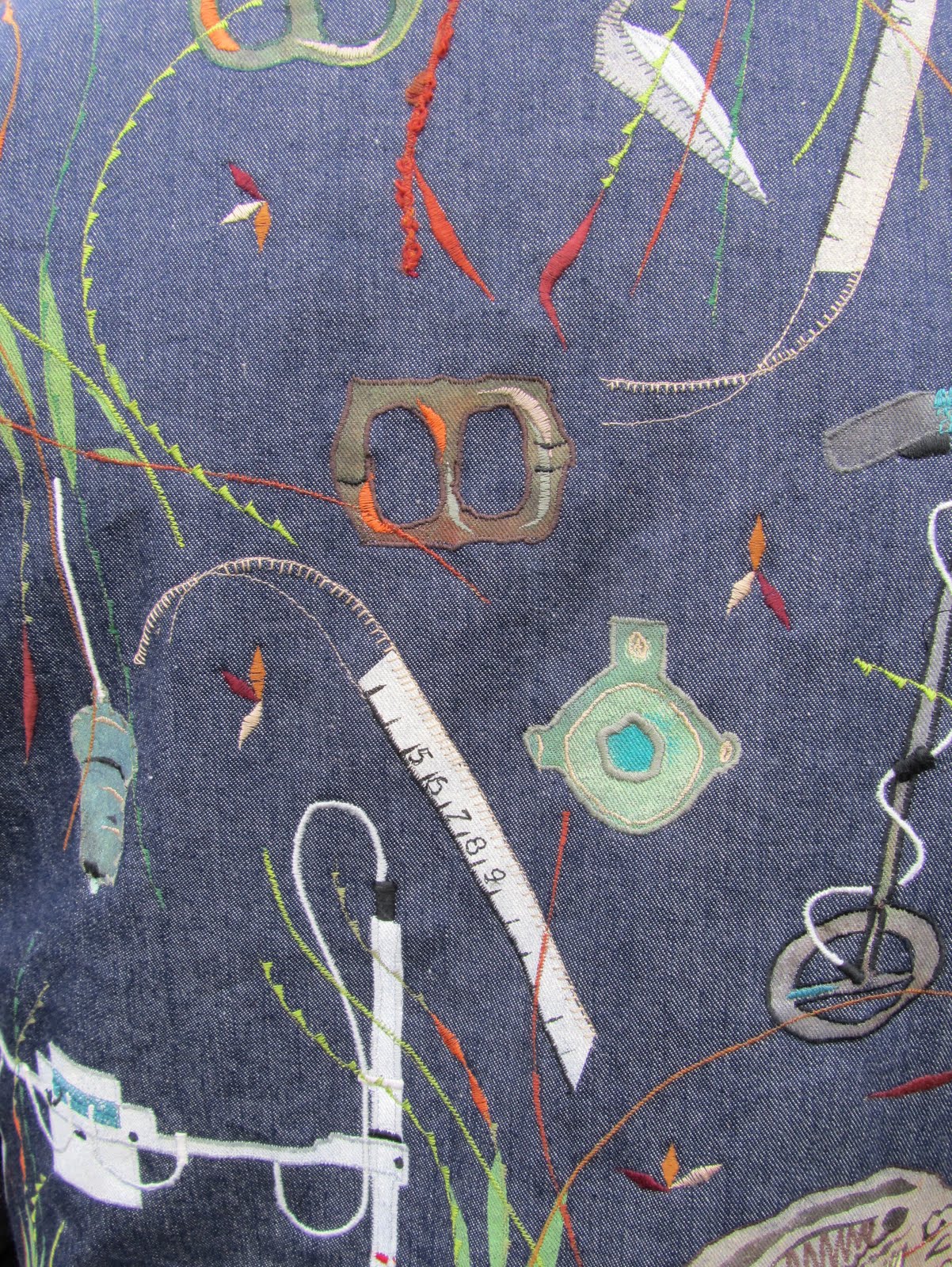
About two years ago I was contacted by someone who wishes to remain anonymous. The request was to commission a long waistcoat.  I was sent images of artifacts found and equipment used on a Roman excavation dig/site.  These included a piece of Roman samian pottery and coins dating back 2000 years.  Also coins, a plum line, Roman broach, buckles, geofizz equipment, trowels, metal detector.

The brief was to put all these items onto denim.   I was given complete artistic freedom.  The sort of challenge I adore.

First of all I created some samples, I particularly liked the Samian pottery and 2000 year old coin.  Have to say it took ages transferring the design onto denim but the result was realistic and pleasing.   Intricate machine embroidery using Husqvarna Lily sewing machine was applied with great effect.

The next challenge was to balance all these items on the blank canvas, this being cut fabric pattern of the garment .   The thing is painting on denim, once it paint hits the fabric it is more or less irreversible.  So it has to be done with extreme care and with precise movement.   Acrylic paint is not very forgiving,  once the item placement has been decided, and the paint hits that area it cannot be removed.   I hasten to add if you get it wrong it means a new start.   Best bit of advice I can give is to practice on a scrap bit of denim to get your colours right on the brush, then go straight to the master work.    I work very quickly and tend not to think too much.  I do not do pre-sketches.  I do make sure that I have a clear head, and that I am in the "right mood" to work and get it right.  I do not like interruptions whilst I am painting.

The work has to be balanced.  After the items are painted on, denim is left to dry, preferably in an airing cupboard for a few days.   Then the real work of embroidery begins.   Its a bit like the paint.  I do not think too much, I go through by thread box and pick out suitable colours and machine embroider until I am happy with the result.  I do not pre-sketch or mark where the embroidery is to go on the fabric.  Its all done whilst the fabric is under the sewing machine foot.   I love couching wool onto fabric, specially textured wool as it seems to bring work to life.  Unpicking is not an option, so having a clear head is important.  Also make sure that your sewing machine is working properly.  New needle, clean of lint, and make sure you are working in good light.


Happy with the result, the garment was then sewn together.  


Please contact me if you have any questions regarding this work.

Thursday, 28 February 2013

Unique Waistcoat Ref: 132 - size 10.

Unique Waistcoat Ref:  132 - Size 8.  


This is a such a cute waistcoat and it seems a shame that it rarely sees the light of day.   My friend was staying with me recently and I asked her to try it on.   It looked absolutely fabulous on her, so I took some photos.   Unfortunately the light was not good, so the accurate colours in this garment can be seen on the images that are not modelled.

The denim is jeans weight 14oz and has been colour discharged randomly to very pale effect.  I no longer practice this method as I do not like flushing lots of chemicals down the drain.  Does not do the environment any good.  Also, after many years of using household bleach it began to affect my eyes, and inhaling it made me feel quite poorly sometimes.  So bleaching denim is not recommended practice.      

Before rushing on, my observations using household bleach is that it varies greatly, depending on what brand used.  I once bought some bleach in a high street shop, when the cap was opened I had to stand back and close my eyes as the fumes were so strong. It was scary.  Different brands of bleach react differently by way of discharging, depending on how much used and how you cover fabric with it.   Some bleach brands are quite mild.  Best results occurred when the denim was washed in a washing machine immediately after bleaching.  I have not experimented with environmentally friendly bleaches.

I have in my possession samples that were bleached to this extent over 20 years ago.  The fabric does change, the bleach may weaken it after many washes.  The samples I have show little deterioration.  I cannot guarantee this will be the case for all though.   In my opinion if it frays a bit, then thats what denim does.  It frays. It looks good.


Getting back to Waistcoat 132:   The Indigo denim was bleached almost white, with some traces of blue visable in random places.   I used one of my constant designs, Robinia or Gum Tree leaves painted in lilac, along with a few random clematis leaves from the same pallette.   Some blue embroidery was introduced to balance the blue peeps of denim.

Using Husqvarna Lily embroidery stitches I created the almost symmetrical lapels.   Not creating lapels but sewing directly onto the denim.  No opportunity for mistakes on this occasion, as unpicking would be visible.  I enhanced the embroidery using a couching method and in my opinion it worked really well.

The image on the right has been scanned so colours are pretty accurate.

I tend to work in a random fashion.  Not planning, just painting, then sewing directly onto the prepared fabric.   Thinking too much about placement takes the edge of for me.   I know this method does not suit everyone.

Embroidered detail of lapel.


The waistcoat back has a tie belt.  For the back and the lining, I have used glazed cotton chintz.   The glaze may loose its lustre after time but I loved the colour so used it.

Further images of this garment can be seen following links from this blog.

This waistcoat is currently for sale £80.00 plus post and packing.  Please contact me for details.