Showing posts with label embroidered denim. Show all posts

Tuesday, 15 December 2015

Spooky True Story about a Waistcoat

Spooky True Story about a Waistcoat

It has been on my radar to write a blog post for several weeks. I was surprised last post was June 2015.   I struggle with juggling home life, work life, creativity, swimming adventures and technology

Yesterday morning I opened https://www.facebook.com/JackieWillsTextileArtist and found a message and a couple of photographs from AB.  I instantly recognised the work in the photographs to be a long sold waistcoat.   Distinctly my style, distressed blue denim with hand painted bamboo and abstract hearts along with added embroidery.

AB asked if I could confirm that it was one of my garments and if so what year.

Well, I could definitely confirm that it was one of my waistcoats, I just hoped that I had a photo to prove it.   I searched through my content and found the exact one, referenced TY 724.  In those days I would make a garment, take a random snap for personal reference and sell it.  The date looked like the year 2000.   In those days photos were non digital and and would be printed out via  by the excellent services of Trueprint.

TY 724 is reproduced below:

AB lives in Spain,  he came across the waistcoat in a charity shop.  He said it had been well looked after and in good condition.  Anyway AB wore it to work in Spain and a few people commented on it. Apparently one person knew the designer (me). Right now I cannot think of anyone I know in Spain! How is that for a spooky coincidence!!

Naturally I am delighted that TY 724 has retired to Spain and has found a new owner who will cherish it as much as the first.  


Tuesday, 12 March 2013

The Roman Archaeology Waistcoat by Jackie Wills

The Roman Archaeology Waistcoat by Jackie Wills


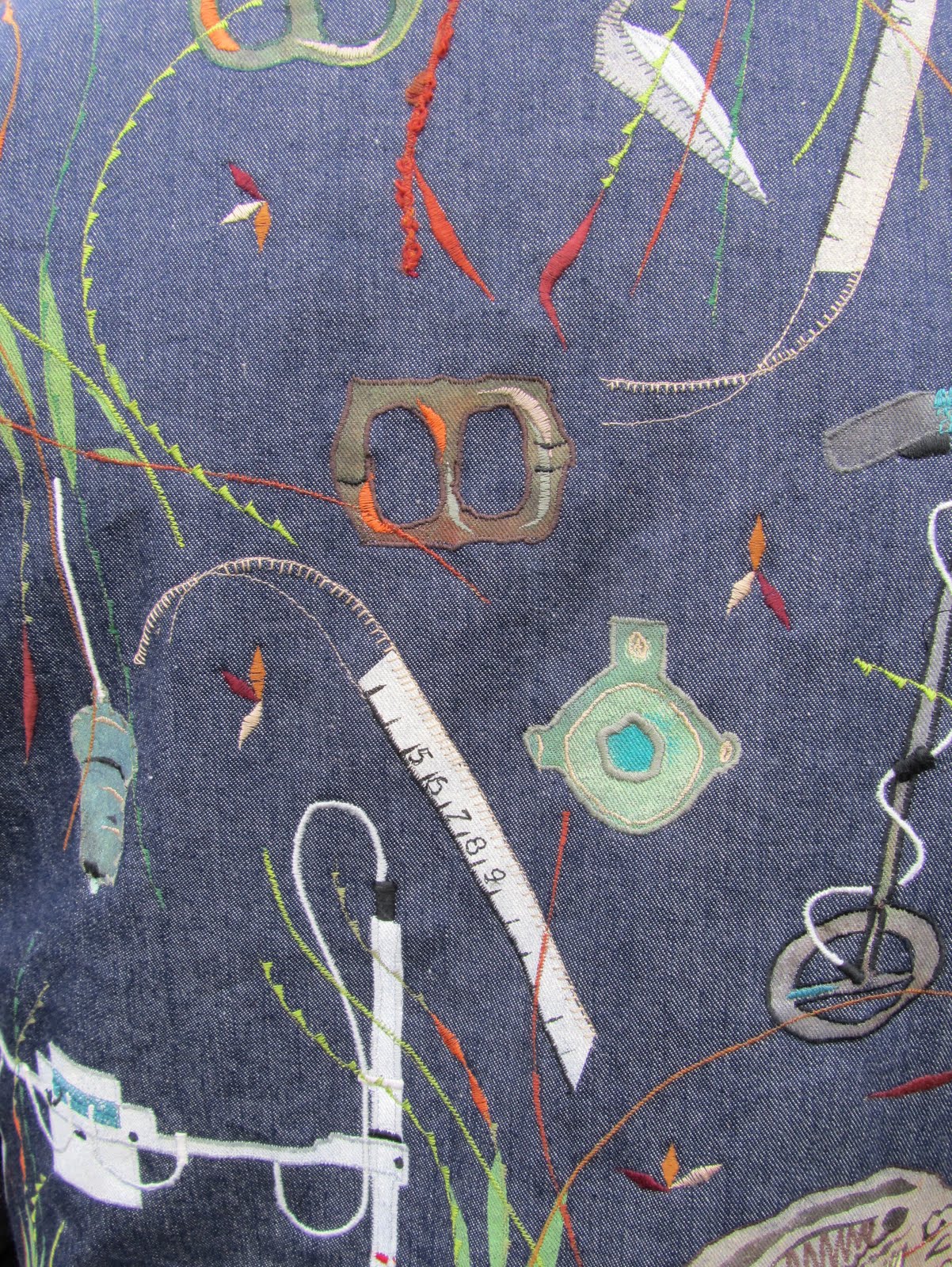
About two years ago I was contacted by someone who wishes to remain anonymous. The request was to commission a long waistcoat.  I was sent images of artifacts found and equipment used on a Roman excavation dig/site.  These included a piece of Roman samian pottery and coins dating back 2000 years.  Also coins, a plum line, Roman broach, buckles, geofizz equipment, trowels, metal detector.

The brief was to put all these items onto denim.   I was given complete artistic freedom.  The sort of challenge I adore.

First of all I created some samples, I particularly liked the Samian pottery and 2000 year old coin.  Have to say it took ages transferring the design onto denim but the result was realistic and pleasing.   Intricate machine embroidery using Husqvarna Lily sewing machine was applied with great effect.

The next challenge was to balance all these items on the blank canvas, this being cut fabric pattern of the garment .   The thing is painting on denim, once it paint hits the fabric it is more or less irreversible.  So it has to be done with extreme care and with precise movement.   Acrylic paint is not very forgiving,  once the item placement has been decided, and the paint hits that area it cannot be removed.   I hasten to add if you get it wrong it means a new start.   Best bit of advice I can give is to practice on a scrap bit of denim to get your colours right on the brush, then go straight to the master work.    I work very quickly and tend not to think too much.  I do not do pre-sketches.  I do make sure that I have a clear head, and that I am in the "right mood" to work and get it right.  I do not like interruptions whilst I am painting.

The work has to be balanced.  After the items are painted on, denim is left to dry, preferably in an airing cupboard for a few days.   Then the real work of embroidery begins.   Its a bit like the paint.  I do not think too much, I go through by thread box and pick out suitable colours and machine embroider until I am happy with the result.  I do not pre-sketch or mark where the embroidery is to go on the fabric.  Its all done whilst the fabric is under the sewing machine foot.   I love couching wool onto fabric, specially textured wool as it seems to bring work to life.  Unpicking is not an option, so having a clear head is important.  Also make sure that your sewing machine is working properly.  New needle, clean of lint, and make sure you are working in good light.


Happy with the result, the garment was then sewn together.  


Please contact me if you have any questions regarding this work.

Thursday, 28 February 2013

Unique Waistcoat Ref: 132 - size 10.

Unique Waistcoat Ref:  132 - Size 8.  


This is a such a cute waistcoat and it seems a shame that it rarely sees the light of day.   My friend was staying with me recently and I asked her to try it on.   It looked absolutely fabulous on her, so I took some photos.   Unfortunately the light was not good, so the accurate colours in this garment can be seen on the images that are not modelled.

The denim is jeans weight 14oz and has been colour discharged randomly to very pale effect.  I no longer practice this method as I do not like flushing lots of chemicals down the drain.  Does not do the environment any good.  Also, after many years of using household bleach it began to affect my eyes, and inhaling it made me feel quite poorly sometimes.  So bleaching denim is not recommended practice.      

Before rushing on, my observations using household bleach is that it varies greatly, depending on what brand used.  I once bought some bleach in a high street shop, when the cap was opened I had to stand back and close my eyes as the fumes were so strong. It was scary.  Different brands of bleach react differently by way of discharging, depending on how much used and how you cover fabric with it.   Some bleach brands are quite mild.  Best results occurred when the denim was washed in a washing machine immediately after bleaching.  I have not experimented with environmentally friendly bleaches.

I have in my possession samples that were bleached to this extent over 20 years ago.  The fabric does change, the bleach may weaken it after many washes.  The samples I have show little deterioration.  I cannot guarantee this will be the case for all though.   In my opinion if it frays a bit, then thats what denim does.  It frays. It looks good.


Getting back to Waistcoat 132:   The Indigo denim was bleached almost white, with some traces of blue visable in random places.   I used one of my constant designs, Robinia or Gum Tree leaves painted in lilac, along with a few random clematis leaves from the same pallette.   Some blue embroidery was introduced to balance the blue peeps of denim.

Using Husqvarna Lily embroidery stitches I created the almost symmetrical lapels.   Not creating lapels but sewing directly onto the denim.  No opportunity for mistakes on this occasion, as unpicking would be visible.  I enhanced the embroidery using a couching method and in my opinion it worked really well.

The image on the right has been scanned so colours are pretty accurate.

I tend to work in a random fashion.  Not planning, just painting, then sewing directly onto the prepared fabric.   Thinking too much about placement takes the edge of for me.   I know this method does not suit everyone.

Embroidered detail of lapel.


The waistcoat back has a tie belt.  For the back and the lining, I have used glazed cotton chintz.   The glaze may loose its lustre after time but I loved the colour so used it.

Further images of this garment can be seen following links from this blog.

This waistcoat is currently for sale £80.00 plus post and packing.  Please contact me for details.

Wednesday, 13 February 2013

1000 Waistcoats later..................

Going to write this blog about once a week.   Last week wrote about my first commission.  This week spring forward 25 years, nearly 1000 waistcoats later to present day.   Its overwhelming to think the first waistcoat could lead to nearly a thousand unique waistcoats.  On reflection it seems like a mammoth waistcoat breeding programme.   One lead to another, lead to meeting another person, lead to a change in style, lead to change in direction, lead to another boundary, to a new fabric, a new technique, lead to tears but most of all lead to personal fulfilment and happiness.

Glancing through my unorganised galleries of work

http://picasaweb.google.com/thejaxcollection


I can recall the creation of each garment, and definitely have favourites. Waistcoat 71 is one of them.   Since 1991 denim has been one of my favourite fabrics after a chance experiment with a pair of old jeans.  More about that in a future blog.

Waistcoat 71 was born in about 1997 when Gordon and I were renovating a Mervyn Seal 1960's style house S'Argamassa (renamed "Sailing Free") on the Marine Drive area of Torquay.   It was a wonderful place to have a studio, despite all the noise of the re-build.

The abstract design of five leaves on a stem was sort of inspired by this house,  I found a chestnut leaf in the garden, of which I created an abstract version.     The embroidery is courtesy of my beloved Bernina 701 sewing machine (circa 1960's) purchased from the Exeter Sewing Machine Company.


Like all my work, the machine stitching is random,  not planned and not marked onto the fabric in advance.  The love hearts can be seen in a number of my garments of that time, a quirky abstract heart, different on each garment applied, with a flume of embroidery cascading until it felt "right" to stop the machine.

The black denim  colour randomly discharged with bleach to create the animal hide effect.   The hand painted designs were applied where the fabric distress is paler for maximum impact.   The leaves have been machine embroidered using satin stitch.  Then turquoise stitching sewn between the leaves.  The garment as one front pocket.   In total there are eight leaf stems and eight hearts.   Strange as I normally work in threes or sixes.

At that time created many garments with "Chestnut Leaf"  theme.  This and another wacky blue denim is still in my collection (waistcoat 47).


Next blog will be about my beloved Bernina 730 Record and Husqvarna Lily sewing machines.  They are both brilliant to use, but both have pros and cons for certain types of work.